Abstract

Word-level forced alignment estimates when each transcript word occurs in a recording. It underpins text-based media editing, subtitling, speech-data curation, and phonetic analysis. Existing evaluations understate how hard the task is: they use short, clean speech, perfect transcripts, and metrics that hide the errors that matter. Real pipelines run on long, diverse recordings and on error-prone ASR output.

We address these gaps with improved evaluation metrics, a scoring protocol for real ASR transcripts, and AlignBench, a benchmark spanning diverse speaker, acoustic, and text conditions. We further introduce FuseAlign, a transformer aligner trained on large-scale pseudo-labeled speech with online label correction. It jointly contextualizes audio and text to localize words coarsely, then refines boundaries at millisecond resolution and detects missing transcript words, without lexicon-based or Viterbi decoding. On AlignBench, FuseAlign substantially outperforms all baselines and stays robust under real ASR transcripts.

The task. Given a recording and its transcript, a forced aligner returns a start and end time for every word.

Measuring alignment the way an edit experiences it

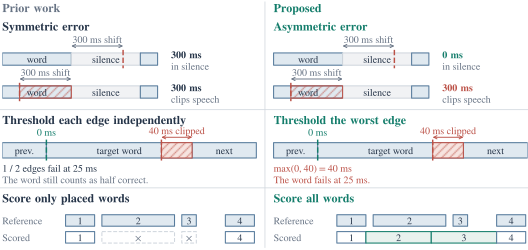
The conventional metrics are the absolute boundary error and per-boundary tolerance rates, computed over the words an aligner chose to place. Each metric misleads when the alignment is used for editing:

Prior versus proposed evaluation of word-level alignment, one row per failure mode.
Prior versus proposed evaluation. Each row is a failure mode. Top: symmetric error penalizes a 300 ms shift equally whether it stays in silence or clips speech; asymmetric error penalizes only the latter. Middle: thresholding each edge independently counts a word with one 40 ms clip as half correct; thresholding the worst edge fails the word. Bottom: scoring only placed words conceals rejected words; a uniform fallback scores every transcript word.
Finally, we score each aligner on real ASR transcripts, not just hand-corrected ones. This mirrors real-world use cases where the transcript may not be perfect. We match ASR words to the reference by edit distance and report the new metrics on words that were present in both the reference and the ASR transcript.

Hear the difference

Given below are some snippets from AlignBench which motivate the new metrics. For each one, play the context, then the word as the reference places it and as Gentle places it, then delete the word with each set of boundaries. The deletion is the honest test: it is the edit a user would make.

AlignBench

TIMIT and Buckeye, the two most commonly used benchmarks for forced alignment, contain recordings of American English speakers, are single-speaker and are recorded under one condition each. To better reflect diverse real-world editing workloads, we created AlignBench, which pools 73 clips from People's Speech, VoxPopuli, and AMI, selected so that their audio, speaker, and transcript statistics match a private sample of real recordings processed by Descript. Selection was frozen before any aligner was evaluated on the pool.

Some high-level statistics of the benchmark: 8,072 words and 0.83 h of long-form, accented, noisy, single- and multi-speaker speech, with 9.6% of words in difficult written forms (numbers, currency, acronyms, named entities). Three annotators independently placed every boundary. All audio is redistributable under its source licence (CC BY / CC0); our transcripts, boundaries, ASR outputs, and evaluation code are CC BY 4.0.

FuseAlign

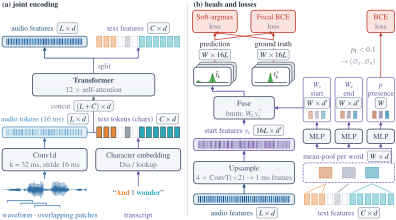
We then built FuseAlign, a model designed from scratch for forced alignment. It is a transformer-based aligner that separates global word localization from local boundary refinement. A joint audio–text transformer matches transcript words to coarse regions of the recording; convolutional heads then refine each start and end on a 1 ms grid. Every word, and each of its two edges, is localized independently, so a transcript mismatch does not shift its neighbours, and a presence head rejects words that were never spoken, as with I in the example below. It is trained on roughly 78,000 hours of pseudo-labeled speech.

FuseAlign architecture: joint encoding of audio patches and character tokens, then per-word boundary heads, losses, and a presence head.
FuseAlign architecture. Audio patches and character tokens are jointly contextualized by a transformer; convolutional refinement then produces millisecond-resolution word-boundary heatmaps, while a presence head rejects absent words.

Results

Baselines: Gentle, MFA 3.0, Nyra , MMS-FA and WhisperX.
Each cell of the main table contains aligner metrics on using hand-corrected / Scribe / Whisper transcripts for the same audio.

AlignBench, every system, three transcript sources. FuseAlign's catastrophic-error rate is 3–11× below the baselines, and the gap widens under the noisier Whisper transcripts. CTC aligners are coarse at every tolerance; MFA's global path fails badly once the transcript stops matching the audio.

We observe that on AlignBench, FuseAlign substantially outperforms all baselines and stays robust under real ASR transcripts. Both catastrophic-error rate and mean error are substantially lower for FuseAlign, indicating that it can detect words in tricky conditions and at the same time, also obtain sharp boundaries.

Nyra leads on clean, read TIMIT speech and Buckeye sits between the regimes: FuseAlign is better in the tail, Nyra at fine tolerances and in the mean. HMM aligners with strong acoustic front-ends stay very precise on narrow, carefully annotated speech while FuseAlign is robust on diverse real-world workloads.

Hear FuseAlign against the baselines

Given below are short AlignBench excerpts where the systems disagree. Each track shows where a system put every word; colours are the worst-edge asymmetric error against the hand-corrected reference, and a dash marks a word the system did not place. Click any word to play exactly the span that system chose, then click the same word in another track and compare.

Paper & Citation

The full paper, with metric definitions, the ASR protocol, benchmark construction, model details, ablations, and all appendices, is on arXiv.

Read on arXiv ↗